
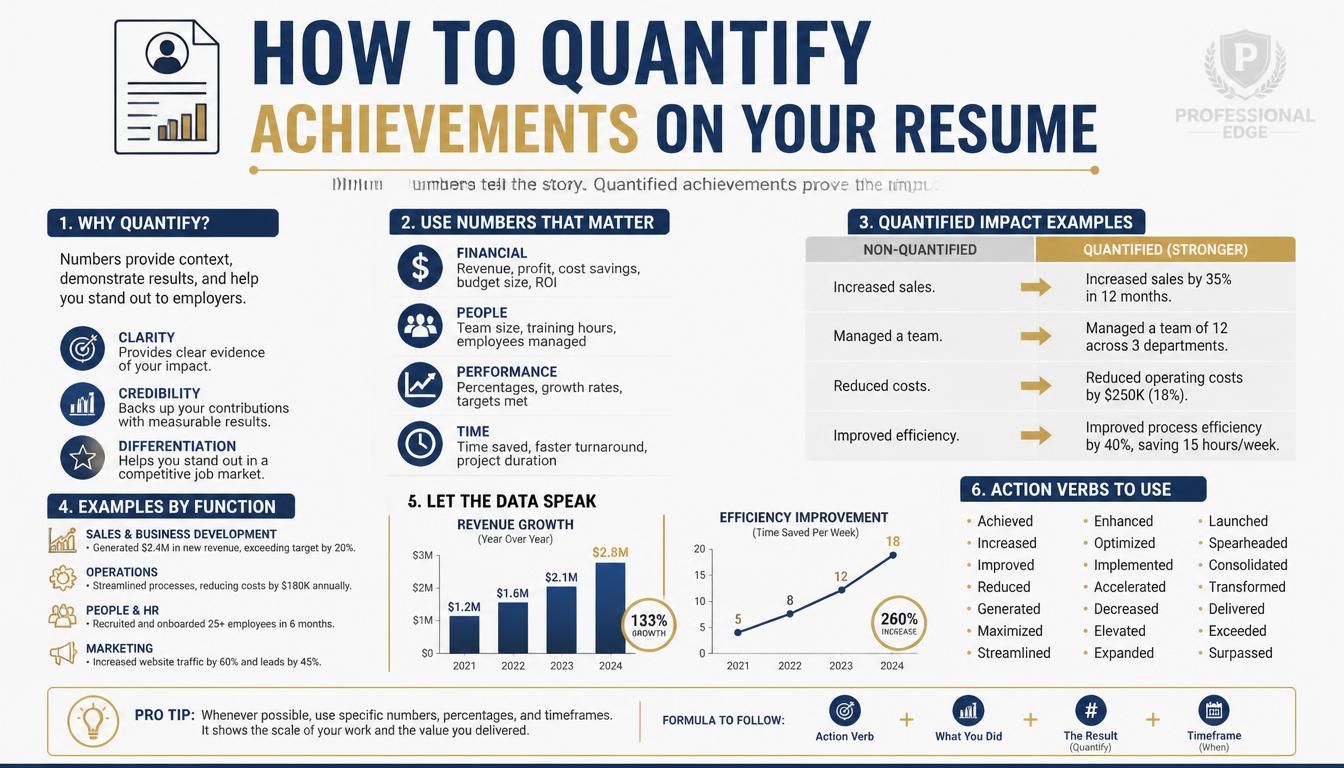
In today's competitive job market, numbers speak louder than words. Candidates who effectively quantify their achievements on resumes are more likely to capture recruiters' attention in 2026. It's not just about listing duties—it's about showcasing impact.
Understanding the Power of Numbers
Quantifying your achievements is essential because it offers tangible proof of your capabilities. Recruiters and hiring managers appreciate concrete evidence of success. For instance, 'Increased sales by 20% in Q1' is more compelling than 'Responsible for sales growth'. Numbers provide context and scale, demonstrating your true impact in previous roles.
Why It Matters Now
With the job market constantly evolving, employers are inundated with applications. Quantifying achievements helps you stand out among the sea of generic resumes. In 2026, advanced ATS systems prioritize resumes with quantifiable data, making it crucial for candidates to incorporate measurable outcomes into their applications.
How to Effectively Quantify Your Achievements
Start by identifying areas where you've made a significant impact:
- Sales and Revenue: Highlight percentage increases or monetary gains, such as 'Boosted revenue by $500K within six months'.
- Efficiency Improvements: If you streamlined a process, quantify the time saved or resource reduction, e.g., 'Reduced processing time by 30%'.
- Team Contributions: Include metrics like 'Led a team of 10 to complete project two weeks ahead of schedule'.
- Customer Satisfaction: Use feedback scores or retention rates, such as 'Achieved a 95% customer satisfaction rate'.
- Cost Savings: Detail budget cuts or cost-saving measures, e.g., 'Saved $200K annually by renegotiating supplier contracts'.
Common Mistakes to Avoid
- Vagueness: Avoid using generic phrases like 'improved' or 'assisted'. Always provide specific numbers.
- Inaccuracy: Double-check your figures to ensure accuracy. Exaggerations can easily be spotted and discredited.
- Irrelevance: Tailor your metrics to align with the job you're applying for, focusing on industry-relevant achievements.
Best Practices for Quantifying Achievements
- Use Action Verbs: Start each bullet point with dynamic verbs like 'Led', 'Increased', or 'Developed'.
- Prioritize Achievements: List your most impressive accomplishments first, ensuring they align with the job description.
- Incorporate Keywords: Use industry-specific terms that resonate with both human recruiters and ATS.
Real-World Example: Before and After
Here's a comparison to illustrate the transformation:
| Statement Type | Before | After |
|---|---|---|
| Weak | "Responsible for managing a team." | "Managed a team of 8, achieving a 20% increase in productivity over six months." |
| Strong | "Developed a new training program." | "Created a training program that resulted in a 30% reduction in onboarding time." |
Frequently Asked Questions
How can I quantify soft skills on my resume? Quantifying soft skills involves illustrating their impact. For example, if your communication skills improved team performance, mention specific feedback scores or project outcomes.
What if I don't have measurable achievements? Consider any informal metrics or feedback you might have received, such as project completion times or customer testimonials.
Can I include achievements from volunteer work? Absolutely. Volunteer experiences can showcase transferable skills and quantifiable achievements, such as organizing events or fundraising.
How do I track achievements for future resumes? Maintain a log of your accomplishments. Use tools like spreadsheets or career management apps to record dates, figures, and outcomes.
Final Thoughts
Quantifying achievements transforms your resume from a static document to a dynamic narrative of success. By articulating the impact of your contributions, you not only enhance your job prospects but also demonstrate your potential value to prospective employers. Start reviewing your career milestones and turn them into compelling, quantifiable achievements today.